
indicator.trading
Trend Types — Uptrend, Downtrend & Sideways Explained

Trend Types — Uptrend, Downtrend & Sideways Explained

beginnerTrading Basics8 min read

Markets move in exactly three directions: up, down, or sideways. That's it. No mystical fourth dimension, no "it's complicated" analysis. Master these three trend types, and you're ahead of 80% of retail traders who overthink everything.

The beauty of trend identification lies in its simplicity. While gurus peddle complex systems with 47 indicators, profitable traders focus on one thing: which way is price moving? This isn't just chart reading — it's the foundation of every trading decision you'll make.

You can't trade what you can't see. If you're struggling to make consistent profits, chances are you're not reading the trend correctly. Let's fix that.

What Are Trend Types

A trend is simply the general direction of price movement over time. Think of it like a river — water flows downhill (downtrend), uphill when pumped (uptrend), or sits still in a lake (sideways). Markets behave the same way, just with money instead of water.

Every chart on every timeframe shows one of three states:

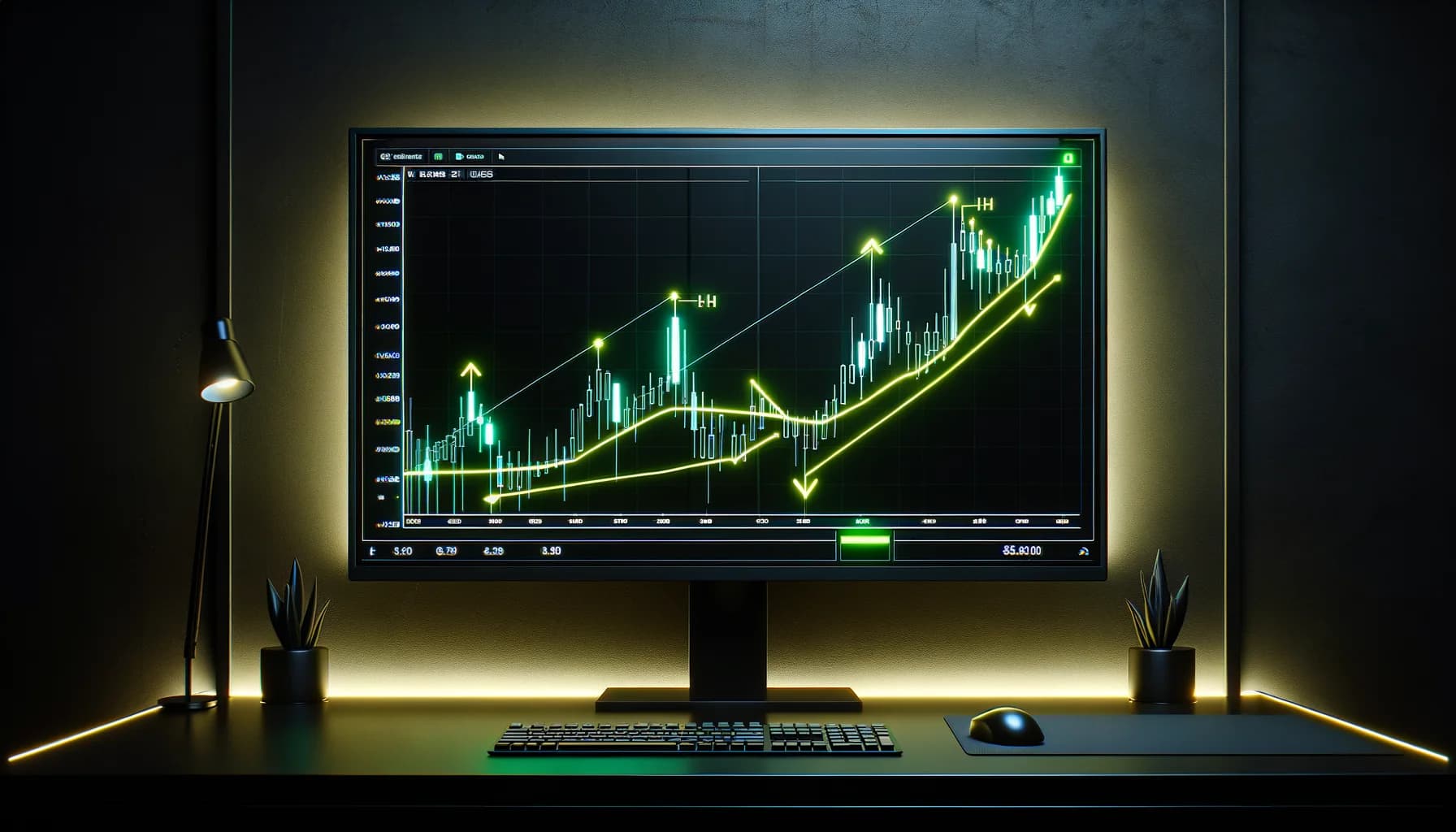
  • Uptrend: Price makes higher peaks and higher valleys
  • Downtrend: Price makes lower peaks and lower valleys
  • Sideways: Price bounces between support and resistance levels

The key word here is "over time." A single green candle doesn't make an uptrend, just like one rainy day doesn't make it winter. Trends develop through a series of price swings that create recognizable patterns.

đź’ˇ Nice to Know: Charles Dow, creator of the Dow Jones Industrial Average, first codified trend theory in the late 1800s. His principles still drive modern technical analysis today.

Understanding market structure helps you see these patterns more clearly. Markets don't move in straight lines — they pulse, creating the swing highs and lows that define trend direction.

FTMO.com - Für seriöse Trader

Uptrend — Higher Highs and Higher Lows

An uptrend occurs when price consistently makes higher highs and higher lows. Picture walking up stairs — each step takes you higher than the last, even though you might pause or step back slightly between steps.

In market terms, this means each peak exceeds the previous peak, and each valley sits above the previous valley. The pattern looks like a staircase ascending from left to right on your chart.

Take Apple (AAPL) in early 2023. The stock climbed from $125 to $180, but not in a straight line. It made higher highs at $140, $155, $165, and $180. Between each high, it pulled back to higher lows at $135, $148, and $160. Classic uptrend structure.

The higher lows are crucial. They show that buyers step in at progressively higher prices, indicating increasing demand. When sellers try to push price down, they can't reach the previous low — bulls won't let them.

🎯 Pro Tip: The simplest trend identification: connect swing lows in an uptrend, swing highs in a downtrend — if the line slopes up, it's bullish.

You'll see uptrends across all timeframes and markets. On a 1-hour EUR/USD chart, an uptrend might span a few days. On a monthly S&P 500 chart, it could last years. The principle remains identical — higher highs and higher lows define the pattern.

Downtrend — Lower Highs and Lower Lows

A downtrend is the mirror opposite of an uptrend. Price makes lower highs and lower lows, creating a descending staircase pattern. Each rally attempt fails to reach the previous peak, and each selloff pushes to new lows.

Think of a ball bouncing down stairs. Each bounce gets progressively lower, even though the ball occasionally bounces higher between steps. The overall direction is clearly down.

Bitcoin's 2022 bear market exemplifies this perfectly. From its November 2021 high around $69,000, BTC created lower highs at $48,000, $32,000, and $25,000. Between each failed rally, it made lower lows at $33,000, $17,500, and finally $15,500.

The lower highs tell the story. Buyers can't maintain momentum at previous levels. Selling pressure overwhelms each bounce attempt, proving that supply exceeds demand at higher prices.

Lower lows confirm the trend. When support breaks and price reaches new lows, it signals that sellers remain in control. Previous support often becomes new resistance, creating those lower highs on subsequent bounces.

⚠️ Watch Out: Trend changes happen gradually — don't call a reversal based on a single candle or bar.

Downtrends can be vicious and fast, especially in leveraged markets like forex or crypto. Gravity works faster than elevators — prices often fall quicker than they rise due to fear and liquidation cascades.

FTMO.com - Für seriöse Trader

Sideways Market — The Range

A sideways market occurs when price oscillates between defined support and resistance levels without making significant progress in either direction. Picture a tennis ball bouncing between two walls — lots of movement, but no net progress.

In ranging markets, price repeatedly tests both upper and lower boundaries. It might touch resistance five times without breaking through, then bounce back to support. The highs and lows stay roughly equal over time.

The EUR/USD pair loves to range. In summer 2023, it spent months bouncing between 1.0800 support and 1.1000 resistance. Traders who recognized this pattern could buy near support and sell near resistance for consistent profits.

Range-bound markets frustrate trend followers but delight range traders. Volume often decreases during ranges as institutional traders wait for a clear breakout direction before committing significant capital.

Ranges eventually break. Accumulation or distribution occurs within these boundaries, building pressure for an eventual breakout. When it comes, the move can be explosive as compressed energy releases.

💡 Nice to Know: Markets spend roughly 70% of their time in ranges and 30% in trends — adapt your strategy accordingly.

Identifying ranges requires patience. New traders often see every small bounce as a trend change, but experienced traders wait for clear breaks of support or resistance with volume confirmation.

How to Identify the Current Trend

Start with the naked chart — no indicators, no noise. Look at price action over the last 20-50 bars and identify the swing highs and lows. Connect them with mental lines or actual trendlines.

For uptrends, draw a line connecting the swing lows. If the line slopes upward and price respects it, you have an uptrend. For downtrends, connect the swing highs. A downward-sloping line that acts as resistance confirms the downtrend.

If you can't draw a clear line in either direction, you're likely looking at a range. This isn't a failure of analysis — it's valuable information. Ranges require different trading strategies than trends.

🎯 Pro Tip: If you can't identify the trend within 5 seconds of looking at a chart, it's probably in a range — and that's useful information.

Time frame matters enormously. Always start with higher timeframes and work down. A stock might show a perfect uptrend on the daily chart while forming a sideways pattern on the 15-minute chart. The daily trend takes precedence.

Moving averages can help, but don't rely on them exclusively. A simple moving average like the 20-period or 50-period can smooth out noise and highlight the underlying trend direction. When price trades consistently above the moving average, it suggests an uptrend.

The market structure approach works best: identify the most recent significant high and low, then see if price is making higher or lower levels. This method works across all timeframes and markets.

FTMO.com - Für seriöse Trader

Trend Strength and Angle

Not all trends are created equal. A steep uptrend with a 45-degree angle differs significantly from a shallow trend that barely slopes upward. The angle tells you about momentum and sustainability.

Steep trends (above 45 degrees) often indicate emotional buying or selling. They're powerful but unsustainable. Think of the meme stock rallies in 2021 — TSLA and GME shot up at extreme angles but couldn't maintain those rates of change.

Moderate trends (20-45 degrees) tend to be healthier and more sustainable. They allow for natural pullbacks and consolidation, letting fundamentals catch up to price action. The best trend following opportunities often come from these measured moves.

Shallow trends (under 20 degrees) might actually be ranges in disguise. If the angle is too shallow, you're probably looking at sideways movement with a slight bias rather than a true trend.

The ADX indicator measures trend strength numerically. Readings above 25 suggest a strong trend, while readings below 20 indicate a weak trend or range. But you can eyeball trend strength just by looking at the angle and consistency of the swings.

Volume confirms trend strength. Strong trends show expanding volume on moves in the trend direction and contracting volume on pullbacks. Weak volume during trending moves suggests the trend may be losing steam.

⚠️ Watch Out: What looks like an uptrend on a 5-minute chart can be a pullback in a downtrend on the daily — always check higher timeframes.

Here's where most traders mess up: they look at one timeframe and think they understand the complete picture. Markets exist simultaneously across multiple timeframes, and trends can conflict between them.

A stock might show:

  • Monthly chart: Strong uptrend (major trend)
  • Daily chart: Sideways range (intermediate trend)
  • 1-hour chart: Short downtrend (minor trend)

Which trend matters? All of them, but the higher timeframe takes priority for position sizing and overall bias. You're looking at a stock in a major uptrend that's consolidating daily and pulling back hourly.

🎯 Pro Tip: Trends on higher timeframes override trends on lower timeframes — always know the big picture first.

This multi-timeframe analysis prevents costly mistakes. Imagine buying a "perfect" breakout on a 15-minute chart, not realizing you're buying into major resistance on the daily chart. The trade might work for minutes or hours but fails when the bigger picture asserts itself.

Smart traders align their trades with higher timeframe trends. If the weekly chart shows an uptrend, they look for buying opportunities on daily pullbacks. They don't fight the major trend with counter-trend trades on lower timeframes.

The general rule: use higher timeframes for trend identification and lower timeframes for entry timing. Let the daily chart tell you what to trade, and the 1-hour chart tell you when to trade it.

FTMO.com - Für seriöse Trader

Trading Each Trend Type

Each trend type requires a different approach. You wouldn't drive a car the same way in city traffic, on highways, and in parking lots. Same principle applies to trading different market conditions.

Trading Uptrends

In uptrends, you want to buy pullbacks to support levels and ride the momentum higher. Look for price to retrace to previous resistance (now support), moving averages, or trendlines before continuing up.

The classic setup: wait for a pullback to the 50% retracement of the last major swing higher. If price holds and starts moving up again, enter long with a stop below the pullback low. Target the next resistance level or a measured move higher.

Never short strong uptrends unless you see clear reversal signals. "The trend is your friend" isn't just a cliché — it's market physics. Fighting established trends burns capital faster than any other mistake.

Trading Downtrends

Downtrends offer short opportunities and require patience for long entries. Sell rallies into resistance levels, but be quick to take profits — bear market rallies can be sharp and violent.

Look for failed bounce attempts at previous support levels (now resistance). When price rallies back to a broken support level and gets rejected, it often continues the downtrend with renewed selling pressure.

If you're long-only (like most stock traders), downtrends mean sitting on your hands or hedging existing positions. Don't try to catch falling knives — wait for clear trend change signals before buying.

Trading Ranges

Range trading is about buying low and selling high within defined boundaries. Identify clear support and resistance levels, then fade moves toward these extremes.

Buy near support with stops below the range low. Sell near resistance with stops above the range high. Take profits before reaching the opposite boundary — don't be greedy and assume price will travel the entire range.

Range breakouts offer the biggest opportunities but also the most false signals. Wait for confirmation through volume, follow-through, or retests before assuming a breakout is legitimate.

Common Trend Identification Mistakes

The biggest mistake? Forcing a trend where none exists. New traders desperately want to see trends everywhere because trending markets seem easier to trade. Reality check: most of the time, markets chop around in ranges.

⚠️ Watch Out: Don't force a trend identification where there isn't one — acknowledging a range is a valid analysis.

Mistake #1: Using too many indicators. Some traders load their charts with 15 different trend indicators, then get confused when they conflict. Price action tells you everything you need to know about trend direction.

Mistake #2: Changing timeframes to fit your bias. If the daily chart doesn't show the trend you want, don't drop to the 5-minute chart to find it. Stick to your primary analysis timeframe and accept what it shows you.

Mistake #3: Calling reversals too early. One red candle in an uptrend doesn't signal a reversal. Wait for clear breaks of trend structure before assuming the trend has changed direction.

Mistake #4: Ignoring the bigger picture. Trading a 1-hour uptrend while the daily chart shows a major downtrend is like swimming upstream — possible, but unnecessarily difficult.

Mistake #5: Overthinking simple concepts. Trend identification isn't rocket science. Higher highs and higher lows = uptrend. Lower highs and lower lows = downtrend. Sideways movement = range. Don't complicate it.

The best trend traders develop pattern recognition through screen time, not through complex formulas or exotic indicators. Look at thousands of charts until trend identification becomes automatic.

FTMO.com - Für seriöse Trader

Key Takeaways

Trend identification is the single most important skill in trading. Everything else — entries, exits, position sizing — flows from correctly reading market direction.

The three trend types cover every possible market condition. Master these patterns and you'll never be confused about what a market is doing. Up, down, or sideways — that's your complete universe of possibilities.

Start every analysis with the higher timeframe trend. Let the weekly or daily chart set your directional bias, then use lower timeframes for precise entry and exit timing. Never fight the major trend with position trades.

Remember that markets spend most of their time in ranges, not trends. Don't force trend trades when markets are chopping sideways. Range trading can be just as profitable when executed properly.

Practice trend identification on different markets and timeframes until it becomes second nature. The patterns are universal — they work on stocks, forex, crypto, commodities, and futures. Master the skill once and apply it everywhere.

FAQ

How do I know when a trend is about to reverse?

Watch for the trend structure to break: in an uptrend, if price makes a lower low (breaks below the last higher low), the trend is potentially reversing. Combine this with divergence on RSI or MACD for confirmation.

What timeframe should I use for trend identification?

Start with daily charts for your primary trend analysis, then use 4-hour charts for intermediate trends and 1-hour charts for entry timing. The daily timeframe filters out most of the noise while showing meaningful trend structure.

How long do trends typically last?

It varies enormously by market and timeframe. Intraday trends might last hours, weekly trends could persist for months, and major trends can run for years. The key is riding them while they last rather than trying to predict their duration.

Should I use moving averages to identify trends?

Moving averages can help smooth out noise, but they lag price action. Use them as confirmation tools rather than primary trend identifiers. Price structure (higher highs/higher lows) gives you faster and more accurate trend signals.

What's the difference between a pullback and a reversal?

A pullback temporarily moves against the trend but maintains the overall trend structure. A reversal breaks the trend structure by making lower lows in an uptrend or higher highs in a downtrend. Pullbacks are buying opportunities; reversals signal trend changes.


Next Read: Ready to dive deeper into market structure? Learn how to spot the exact moments when trends change in our guide to Market Structure — Reading the Framework of Price.

Was this helpful?

Continue Learning

Trend Types — Uptrend, Downtrend & Sideways Explained | indicator.trading