indicator.trading
Wyckoff Method — The Original Smart Money Framework

Wyckoff Method — The Original Smart Money Framework

advancedAdvanced Concepts13 min read

Richard Wyckoff figured out over a century ago what today's traders call "smart money." While modern concepts like Smart Money Concepts (SMC) and institutional trading get all the attention, Wyckoff laid the foundation for understanding how large players accumulate, distribute, and move markets.

His method breaks down market cycles into four simple phases that repeat endlessly across all timeframes. The beauty? It's not about indicators or complex calculations — it's about reading the story behind price action through the lens of supply, demand, and institutional behavior.

Most traders stumble around looking for the "next hot strategy" while ignoring the framework that's been working for over 100 years. Let's fix that.


What Is the Wyckoff Method

The Wyckoff Method is a technical analysis approach that views markets through the actions of large operators who accumulate shares quietly, mark up prices aggressively, distribute at high prices, then mark down to repeat the cycle.

Think of it like a pump-and-dump scheme, except it's completely legal and happens naturally in every liquid market. The smart money (institutions, funds, whales) can't just buy or sell massive positions instantly without moving prices against themselves.

Instead, they accumulate during boring, sideways periods when retail traders get impatient and sell. Once they've loaded up, they aggressively mark prices higher. At the top, they distribute their holdings to eager buyers who think the trend will continue forever.

The method gives you a roadmap to follow institutional footprints rather than fighting them. When you understand which phase the market is in, you can position yourself alongside the smart money instead of becoming their exit liquidity.

đź’ˇ Nice to Know: Wyckoff worked as a stock operator in the early 1900s, learning directly from legendary traders like Jesse Livermore. His insights come from actually moving markets, not just studying them.

FTMO.com - Für seriöse Trader

The Composite Operator

Wyckoff introduced the concept of the Composite Operator — imagine all the large institutional players (banks, funds, market makers) acting as one giant entity with unlimited resources and insider knowledge.

This operator doesn't care about your technical analysis or retail sentiment. They have one job: accumulate low, distribute high, and profit from the spread. They know where the stops are clustered, where retail is positioned, and exactly how to trigger maximum pain.

The Composite Operator's playbook is predictable once you recognize it. They shake out weak hands during accumulation with fake breakdowns. They create FOMO during markup phases. They distribute into euphoria when everyone thinks prices can only go up.

Modern markets might be faster and more complex, but the Composite Operator's strategy remains unchanged. Today's institutional algorithms and smart money techniques are just high-tech versions of the same century-old game plan.

🎯 Pro Tip: Think of the Composite Operator as the aggregate behavior of institutions — they accumulate quietly before marking up. When you see unexplained strength on bad news or weakness on good news, that's the Composite Operator at work.

Wyckoff's Three Laws

Wyckoff built his method on three fundamental laws that explain how markets actually work beyond the surface chaos of daily price movements.

The Law of Supply and Demand states that prices rise when demand exceeds supply and fall when supply exceeds demand. Sounds obvious, but most traders ignore this basic truth when chasing momentum or fighting clear trends.

The Law of Cause and Effect explains that every significant price move (effect) must be preceded by a period of preparation (cause). The bigger the cause (accumulation or distribution range), the bigger the effect (markup or markdown move).

The Law of Effort vs. Result compares price movement (result) to volume (effort). When you see huge volume but small price movement, something's wrong — usually smart money is quietly accumulating or distributing against the crowd.

These laws work together to reveal market intentions. A narrow trading range with declining volume often precedes major moves. Wide price swings on low volume usually signal exhaustion.

⚠️ Watch Out: Don't force every chart into a Wyckoff template — the method works best on liquid markets with clear institutional activity.

FTMO.com - Für seriöse Trader

The Four Market Phases

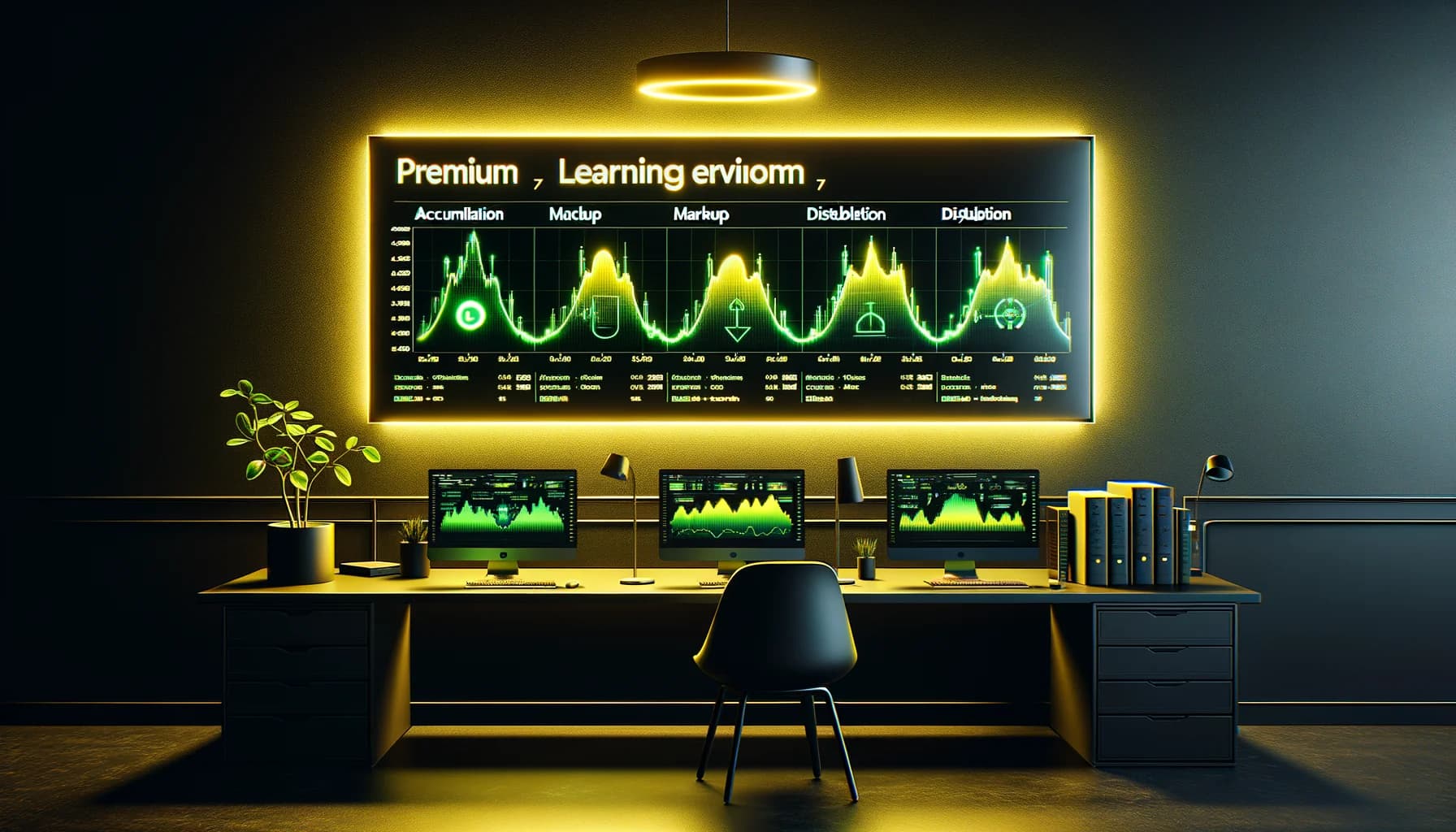
Every Wyckoff cycle contains four distinct phases that play out like clockwork across all timeframes, from daily charts to decades-long cycles.

Phase A (Accumulation) happens after significant declines when smart money quietly absorbs shares from panicked sellers. Price moves sideways in a range while institutions build positions without alerting the market.

Phase B (Markup) begins when accumulation is complete and smart money starts pushing prices higher. This creates the trending moves that most traders try to catch, but by then the easy money is already made.

Phase C (Distribution) occurs at market tops when institutions unload their positions to retail buyers who think the party will continue forever. Price ranges again, but this time smart money is selling into strength.

Phase D (Markdown) starts when distribution is complete and there's no one left to buy. Prices collapse as reality sets in and retail finally realizes they're holding the bag.

The key insight is that phases A and C (the ranging phases) are where smart money does their real work. Phases B and D (the trending phases) are just the inevitable result of their preparation.

Understanding which phase you're in determines your strategy. Trade breakouts during markup, fade rallies during distribution, and look for accumulation after significant declines.

Accumulation Phase — Step by Step

Accumulation unfolds in predictable stages that you can learn to recognize in real-time with enough practice and screen time.

The phase begins with a Selling Climax (SC) — a dramatic price drop on huge volume as the last sellers panic out of their positions. This isn't the bottom yet, but it marks the beginning of the end for the downtrend.

After the climax, price rallies weakly to create an Automatic Rally (AR). Volume should be lighter than the selling climax, showing that buying pressure is limited. The high of this rally becomes important resistance later.

Price then pulls back to test the selling climax low, creating a Secondary Test (ST). Ideally, this test holds above the SC low on lower volume, proving that selling pressure is diminishing.

The real accumulation happens in the trading range that forms between the SC low and AR high. Smart money uses this range to quietly build positions while retail traders get bored and leave.

The accumulation phase ends with a Spring — a false breakdown below the range that quickly reverses. This final shakeout triggers remaining stops and allows smart money to absorb the last supply before markup begins.

🎯 Pro Tip: The Spring (false break below accumulation range) is the highest probability Wyckoff entry — smart money absorbs supply and reverses price.

FTMO.com - Für seriöse Trader

Distribution Phase — Step by Step

Distribution is accumulation's evil twin — the same structure but with opposite intentions as smart money unloads positions into retail enthusiasm.

The phase starts with a Buying Climax (BC) where price explodes higher on massive volume as the last buyers pile in at exactly the wrong time. Unlike healthy markup moves, this climax feels desperate and unsustainable.

Price then drops to form an Automatic Reaction (AR) as early sellers take profits. The low of this reaction becomes important support that will be tested multiple times during distribution.

Multiple Secondary Tests (ST) follow as price rallies back toward the buying climax high. Each test should show weaker volume and less enthusiasm, proving that buying pressure is fading.

The distribution range forms between the BC high and AR low. While retail sees consolidation before the next leg higher, smart money is quietly selling into every rally and bounce.

Distribution ends with an Upthrust (UT) — a false breakout above the range that quickly fails. This final trap catches breakout traders and allows smart money to dump their remaining positions before markdown begins.

The key difference from accumulation is volume behavior. In accumulation, volume decreases on declines and increases on rallies. In distribution, volume increases on rallies as smart money sells, but the price gains become weaker over time.

đź’ˇ Nice to Know: Volume is essential in Wyckoff: accumulation shows declining volume on drops and increasing volume on rallies. Distribution shows the opposite pattern.

Wyckoff Events — Spring, Upthrust, SOS, SOW

Specific events within Wyckoff phases provide the highest-probability trading signals when you learn to spot them consistently.

A Spring occurs during accumulation when price breaks below the trading range, triggers stops, then quickly reverses higher. Smart money uses this false breakdown to absorb the final supply and complete their accumulation process.

An Upthrust happens during distribution when price breaks above the range, attracts breakout buyers, then immediately reverses lower. This false breakout allows smart money to distribute their final positions to eager bulls.

Sign of Strength (SOS) events show up during accumulation when price rallies on increasing volume, proving that demand is beginning to outweigh supply. These rallies hold their gains and don't immediately fade.

Sign of Weakness (SOW) events appear during distribution when price drops on increasing volume, showing that supply is overwhelming demand. Unlike healthy pullbacks, these drops feel heavy and struggle to recover.

The power of these events lies in their predictive value. A successful spring often leads to strong markup moves. A confirmed upthrust frequently precedes sharp markdown phases.

Trading these events requires patience and discipline. Wait for the false move to complete and reverse before entering. The best signals combine the Wyckoff event with Volume Spread Analysis (VSA) for confirmation.

⚠️ Watch Out: Wyckoff analysis is highly subjective — it takes years to identify phases correctly in real-time.

FTMO.com - Für seriöse Trader

Trading Wyckoff in Modern Markets

Today's electronic markets move faster than Wyckoff's era, but the underlying principles remain unchanged because human psychology and institutional behavior are constants.

Modern Wyckoff traders focus on higher timeframes where the noise gets filtered out and the true institutional intentions become clearer. Daily and weekly charts often show cleaner Wyckoff structures than intraday timeframes.

Liquidity concepts complement Wyckoff perfectly. Springs and upthrusts typically target liquidity pools where stops cluster. Smart money knows exactly where these levels sit and uses Wyckoff events to access that liquidity.

The rise of algorithmic trading has made Wyckoff events more precise but also more violent. Modern springs and upthrusts happen faster and reverse more aggressively than in Wyckoff's manual trading days.

Cryptocurrency markets provide excellent Wyckoff examples because they're less regulated and institutional behavior is more obvious. The same patterns that worked in 1920s stocks play out clearly in today's crypto cycles.

Market Structure analysis works hand-in-hand with Wyckoff phases. Markup phases create higher highs and higher lows. Markdown phases do the opposite. Accumulation and distribution phases create ranging structure.

🎯 Pro Tip: The best Wyckoff trades combine the phase analysis with VSA (Volume Spread Analysis) for bar-by-bar confirmation.

Common Wyckoff Mistakes

New Wyckoff traders make predictable errors that can be avoided with proper understanding and realistic expectations.

The biggest mistake is trying to identify every single phase in real-time. Not every range is meaningful accumulation or distribution — sometimes markets just consolidate randomly without institutional involvement.

Many traders force Wyckoff labels onto charts retroactively, making everything look like textbook examples after the fact. This creates false confidence that doesn't translate to live trading success.

Another error is ignoring timeframe context. A distribution phase on the 4-hour chart might occur within a larger accumulation phase on the daily chart. Always consider the bigger picture before making trading decisions.

Impatience kills most Wyckoff traders. The method requires waiting for clear phase development and high-probability events like springs and upthrusts. Trying to trade every wiggle within the phases leads to poor results.

Volume analysis gets overlooked despite being crucial for Wyckoff success. Price action alone can be misleading, but volume reveals the true intentions behind the movements.

Finally, many traders expect Wyckoff to work in all market conditions. The method shines in liquid markets with clear institutional participation but struggles in thin, retail-dominated assets.

⚠️ Watch Out: Not every range is Wyckoff accumulation or distribution — sometimes price is just consolidating randomly.

FTMO.com - Für seriöse Trader

Key Takeaways

The Wyckoff Method provides a timeless framework for understanding how smart money operates in all markets and timeframes. The four phases (accumulation, markup, distribution, markdown) repeat endlessly because they reflect the natural cycle of institutional position building and liquidation.

Focus on identifying clear accumulation and distribution ranges rather than trying to catch every minor phase. The highest-probability trades come from springs, upthrusts, and other definitive Wyckoff events that show smart money's hand.

Volume analysis is non-negotiable for Wyckoff success. Price tells you what happened, but volume tells you why it happened and whether the move has institutional backing.

Patience separates successful Wyckoff traders from the rest. The method rewards those who wait for clear phase development and obvious smart money footprints rather than forcing trades in ambiguous situations.

Modern concepts like Smart Money Concepts and Order Flow are evolutionary improvements on Wyckoff's original insights. Understanding the foundation helps you better apply contemporary techniques.

The Composite Operator's game plan hasn't changed in over 100 years. They still accumulate during fear, markup during hope, distribute during greed, and markdown during despair. Position yourself accordingly.

FAQ

Is the Wyckoff Method still relevant today?

Yes, absolutely. The underlying principles (institutional accumulation/distribution, supply/demand, composite operator) are timeless because markets are still driven by large players who need to accumulate and distribute positions. Many modern SMC concepts are essentially repackaged Wyckoff principles.

How long does each Wyckoff phase typically last?

Phase duration varies dramatically based on timeframe and market conditions. On daily charts, accumulation or distribution phases might last weeks to months. The key is recognizing the phase characteristics rather than timing specific durations.

Can Wyckoff be applied to cryptocurrency markets?

Crypto markets often show cleaner Wyckoff patterns than traditional markets because they're less regulated and institutional behavior is more transparent. The same four-phase cycles play out clearly across major cryptocurrency price movements.

What's the difference between Wyckoff and Smart Money Concepts?

SMC is essentially modern Wyckoff with updated terminology and refined execution techniques. Wyckoff provides the theoretical framework while SMC focuses on practical implementation using concepts like liquidity sweeps, fair value gaps, and order blocks.

How do you confirm a Wyckoff spring or upthrust?

Confirmation comes from immediate reversal with increased volume in the opposite direction. A true spring breaks below support, triggers stops, then quickly reverses higher on strong volume. Failed springs continue lower and invalidate the accumulation theory.


Next Read: Ready to see how Wyckoff principles evolved into modern trading? Check out Smart Money Concepts (SMC) — The Complete Guide to learn how today's traders apply institutional logic with contemporary tools and terminology.

Was this helpful?

Continue Learning

Wyckoff Method — The Original Smart Money Framework | indicator.trading