

indicator.trading
Stochastic RSI — Ultra-Sensitive Momentum Signals

Stochastic RSI — Ultra-Sensitive Momentum Signals

intermediateMomentum Indicators8 min read

The Stochastic RSI (StochRSI) takes the regular RSI and cranks up the sensitivity dial to eleven. It's like taking a sports car and adding a turbo charger — you get way more responsiveness, but also way more chances to crash if you don't know what you're doing.

This indicator applies the Stochastic oscillator formula to RSI values instead of price data. The result? An oscillator that moves between 0 and 100 but changes direction much faster than either the RSI Indicator or Stochastic Oscillator alone.

StochRSI was developed by Tushar Chande and Stanley Kroll in 1994. They noticed that RSI could stay in overbought or oversold territory for extended periods, making timing entries frustrating. Their solution was to make RSI more responsive by applying Stochastic math to it.

The math looks intimidating, but here's what's actually happening: StochRSI takes the current RSI value, finds where it sits relative to the highest and lowest RSI values over a lookback period, then converts that to a 0-100 scale.

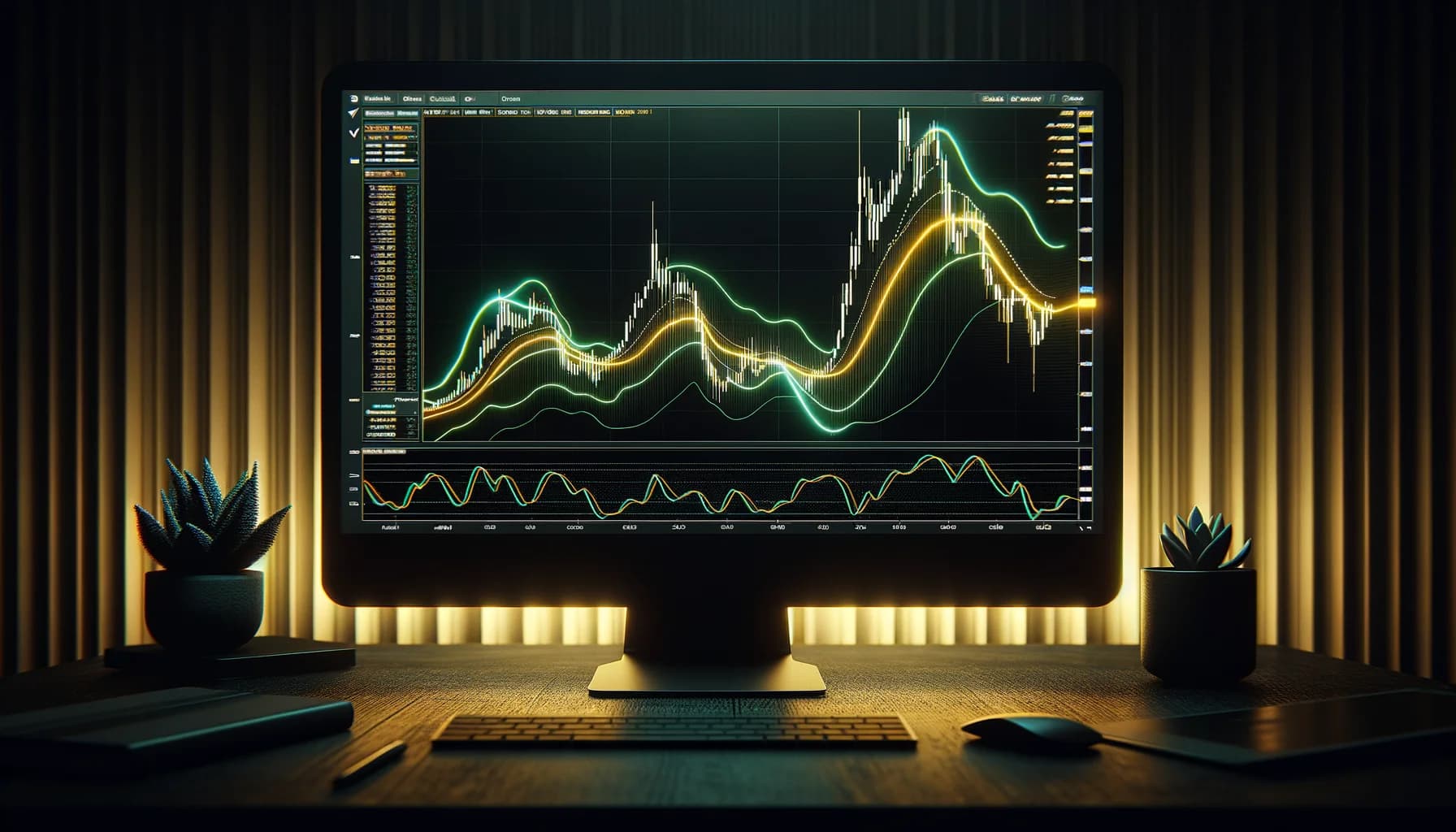
What Is StochRSI

StochRSI measures where the current RSI value ranks compared to its recent range. Think of it like grading on a curve — instead of asking "is this RSI high or low," StochRSI asks "is this RSI high or low compared to where it's been lately?"

The indicator oscillates between 0 and 100, with readings above 80 typically considered overbought and below 20 oversold. But here's where it gets interesting — StochRSI can hit these extreme levels multiple times in a single trend, unlike regular RSI which might camp out at 70+ for weeks.

Most trading platforms display StochRSI as two lines: %K (the main line) and %D (a smoothed version, usually a 3-period moving average of %K). The crossovers between these lines generate the actual trading signals.

The calculation uses a default 14-period lookback for both the initial RSI calculation and the Stochastic transformation. This means you're looking at how today's 14-period RSI compares to the highest and lowest 14-period RSI values over the past 14 periods.

💡 Nice to Know: StochRSI will show values of 100 when RSI is at its highest point in the lookback period, and 0 when RSI is at its lowest point — even if the actual RSI values are nowhere near the traditional 30/70 levels.

FTMO.com - Für seriöse Trader

How It Differs from RSI and Stochastic

Regular RSI moves relatively slowly and can get "stuck" in overbought or oversold territory during strong trends. You'll see RSI hit 80 in an uptrend and just sit there for weeks while price keeps climbing. Frustrating when you're trying to time entries.

The Stochastic Oscillator compares current price to the recent price range. It's more responsive than RSI but can get choppy in sideways markets. Stochastic works great in ranging markets but gives lots of false signals during trends.

StochRSI combines the trend-following nature of RSI with the sensitivity of Stochastic. It rarely gets stuck in extreme zones because it's constantly recalibrating based on recent RSI behavior. When RSI starts trending higher, StochRSI will quickly move toward 100, then reset as that becomes the new normal.

This creates a different signal pattern. While RSI might show overbought conditions for weeks, StochRSI will cycle through overbought and oversold multiple times within that same period. You get more trading opportunities, but also more noise.

The key difference is timeframe sensitivity. RSI and Stochastic give you the "big picture" momentum view, while StochRSI gives you the "right now" momentum view within that bigger context.

🎯 Pro Tip: Use RSI to determine the overall momentum direction, then use StochRSI to time your entries within that trend. If RSI is above 50 and rising, look for StochRSI oversold bounces rather than overbought reversals.

Ultra-Sensitivity — Pros and Cons

StochRSI's ultra-sensitivity is both its superpower and its kryptonite. The same characteristic that makes it excellent for quick entries also makes it prone to false signals.

The upside is obvious: you catch momentum shifts much earlier. When a stock starts reversing from oversold levels, StochRSI will signal the change days or even weeks before regular RSI budges. In fast-moving markets like crypto or during earnings season, this early warning system can be invaluable.

But that sensitivity comes with a price. StochRSI generates significantly more signals than RSI or Stochastic alone. More signals means more potential trades, but also more whipsaws. You'll find yourself getting stopped out of perfectly good setups because StochRSI flickered the wrong way for a day or two.

The indicator also has a tendency to give premature reversal signals during strong trends. StochRSI might show oversold conditions and start bouncing while the underlying trend continues pushing lower for several more days.

This is where understanding market context becomes crucial. StochRSI works brilliantly in choppy, range-bound markets where its sensitivity helps you catch every swing. But in strong trending markets, that same sensitivity becomes a liability.

⚠️ Watch Out: StochRSI can easily generate 3-4 signals per week on daily charts during volatile periods. If you're not selective about which signals to take, you'll overtrade yourself into losses even when your directional bias is correct.

Think of StochRSI like a smoke detector — it's designed to alert you at the first sign of change, even if that change turns out to be just someone burning toast. The key is learning to distinguish between real fires and false alarms.

FTMO.com - Für seriöse Trader

StochRSI for Crypto

Crypto markets and StochRSI are practically made for each other. The 24/7 nature of crypto creates perfect conditions for StochRSI's high-frequency signal generation, and the volatility means those signals often lead to meaningful moves.

Bitcoin and major altcoins respond particularly well to StochRSI signals on 4-hour and daily timeframes. The constant price action means StochRSI rarely gets "stuck" in extreme zones the way it might with slower-moving traditional assets.

For Bitcoin, StochRSI oversold bounces (below 20) often coincide with significant support level tests. When BTC hits a major support area and StochRSI simultaneously shows oversold with bullish divergence, those setups have historically produced strong risk-to-reward trades.

Ethereum tends to show cleaner StochRSI patterns than Bitcoin, possibly due to different trading dynamics. ETH often gives textbook StochRSI crossover signals that align well with key technical levels.

Smaller cap altcoins benefit from StochRSI's sensitivity during accumulation phases. When an altcoin is building a base, StochRSI will cycle through multiple overbought/oversold readings, giving you several opportunities to add to positions during the consolidation.

The key with crypto is matching your timeframe to the market's current volatility regime. During high volatility periods, even hourly StochRSI can generate tradeable signals. During crypto winter phases, you might need to move to daily or even weekly charts to avoid excessive noise.

💡 Nice to Know: Many crypto traders use StochRSI on multiple timeframes simultaneously — 1-hour for entry timing, 4-hour for trend context, and daily for overall market positioning. This multi-timeframe approach helps filter out the worst false signals.

Settings and Timeframes

The standard StochRSI settings are 14 periods for RSI calculation, 14 periods for the Stochastic lookback, with %K smoothed over 3 periods and %D smoothed over 3 periods. These defaults work reasonably well, but you can definitely optimize them for your trading style.

For day trading, try shortening the RSI period to 8 or 10. This makes the underlying RSI more responsive, which then makes StochRSI even more sensitive. Pair this with 5-minute or 15-minute charts for very active momentum scalping.

Swing traders often prefer lengthening the periods to reduce noise. An RSI period of 21 with a Stochastic lookback of 21 creates a smoother StochRSI that generates fewer but higher-quality signals on daily charts.

The smoothing periods (%K and %D) control how much the signal lines jump around. Increasing these from 3 to 5 or even 7 can eliminate some false crossovers, but you'll sacrifice some responsiveness in the process.

Timeframe selection matters enormously with StochRSI. On 5-minute charts, you'll get dozens of signals per day — most of them noise. On weekly charts, you might wait months for a clear signal, but when it comes, it's usually significant.

The sweet spot for most traders is 1-hour to daily charts. This gives you enough signal frequency to stay engaged without drowning in false positives. If you're trading crypto, 4-hour charts often provide the best balance of responsiveness and reliability.

🎯 Pro Tip: When backtesting StochRSI settings, don't just optimize for win rate. The most responsive settings often produce the highest win rates but also the highest trading frequency and transaction costs. Focus on risk-adjusted returns after costs.

Consider market-specific adjustments too. Forex pairs might need different settings than individual stocks. Commodities often require longer periods due to their different volatility patterns. There's no one-size-fits-all solution.

FTMO.com - Für seriöse Trader

Key Takeaways

StochRSI excels as a timing tool within a broader market context rather than a standalone trading system. Use it to refine your entries and exits, not to determine your overall market direction.

The indicator works best in volatile, range-bound markets where its sensitivity helps capture short-term momentum shifts. In strong trending markets, you'll often get better results waiting for StochRSI to align with the trend rather than fighting it.

Combine StochRSI with price action analysis for the best results. A StochRSI oversold reading means much more when it occurs at a key support level with bullish divergence than when it happens in the middle of nowhere.

Don't ignore the %K and %D crossovers. While overbought/oversold levels get most of the attention, the crossover signals often provide better entry timing with clearer risk management levels.

Remember that ultra-sensitivity is a double-edged sword. You'll catch more moves, but you'll also endure more false signals. Position sizing becomes even more critical when trading with high-frequency indicators like StochRSI.

Finally, always consider the broader market context. StochRSI signals during earnings season, major news events, or extreme market volatility should be treated with extra caution. The indicator assumes normal market behavior, which doesn't always apply during unusual circumstances.

FAQ

What's the difference between StochRSI and regular Stochastic?

Regular Stochastic compares current price to the recent high-low range, while StochRSI compares current RSI to the recent RSI range. This makes StochRSI much more sensitive to momentum changes since it's working with smoothed RSI data rather than raw price data.

Can StochRSI be used for position sizing?

Not directly. StochRSI is primarily a timing indicator for entries and exits. However, you can use the strength of StochRSI signals (clear vs. marginal overbought/oversold levels) to adjust position sizes — taking larger positions on stronger signals and smaller positions on weaker ones.

Why does StochRSI give so many false signals?

The ultra-sensitivity that makes StochRSI responsive also makes it prone to noise. Every small momentum shift registers as a signal, including temporary moves that quickly reverse. This is why combining StochRSI with other forms of analysis (support/resistance, trend direction, volume) is essential for filtering out the false positives.

What's the best timeframe for StochRSI in forex trading?

For forex, 1-hour and 4-hour charts typically provide the best balance of signal frequency and reliability. Daily charts work well for longer-term positioning, while anything shorter than 1-hour tends to generate too much noise due to forex's 24-hour nature and lower volatility compared to stocks or crypto.


Master the basics first with our comprehensive guide on the RSI Indicator — How to Actually Use It, where you'll learn the foundation that makes StochRSI possible.

Was this helpful?

Continue Reading

RSI Indicator — How to Actually Use It

Continue Learning

Stochastic RSI — Ultra-Sensitive Momentum Signals | indicator.trading